Family details in a marriage biodata: what to write
For many families the family section is read as closely as the education and career lines. It answers the questions every elder asks first: who are the parents, what do they do, where are they from, and who else is in the family.
This guide explains each field, shows how to describe parents and siblings, and gives three full examples. All of the families in them are fictional.
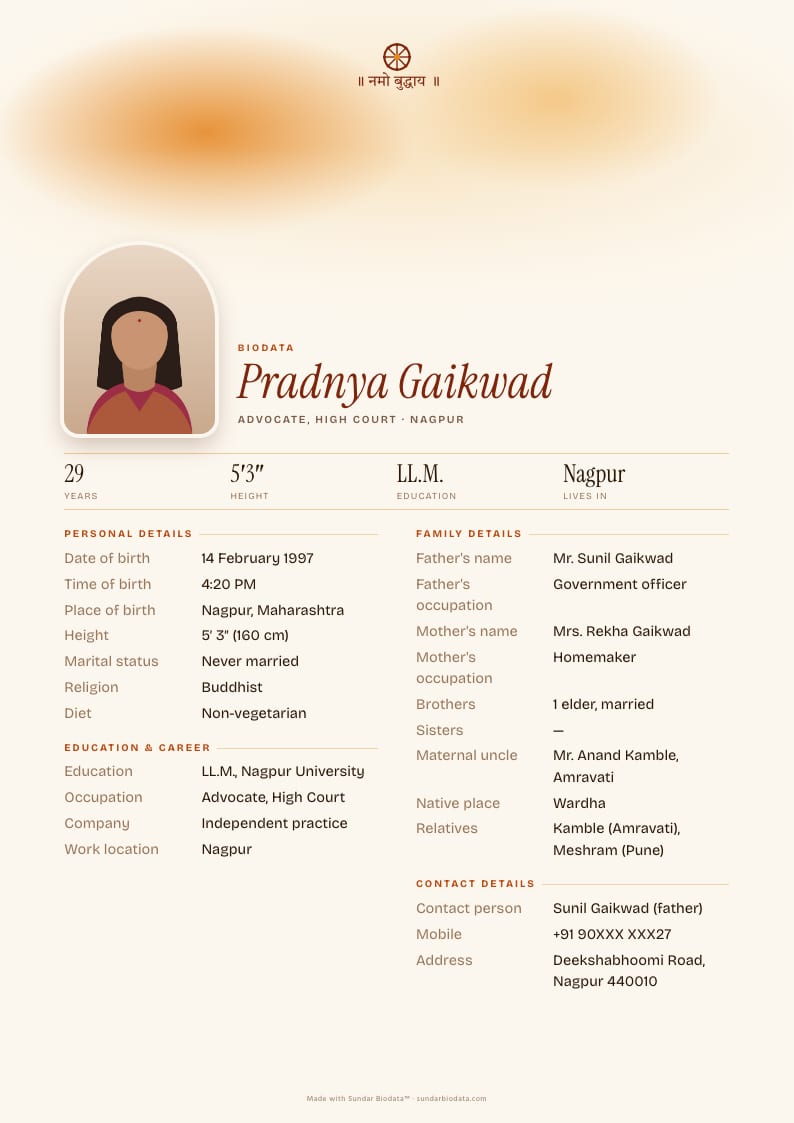
The fields most families include
| Field | What to write | Example |
|---|---|---|
| Father’s name | Full name with Mr. or Shri | Mr. Prakash Joshi |
| Father’s occupation | Role and where, or “retired” with the last role | Retired as headmaster, Zilla Parishad school |
| Mother’s name | Full name with Mrs. or Smt. | Mrs. Vandana Joshi |
| Mother’s occupation | Role, or homemaker | Homemaker |
| Brothers | Number, elder or younger, married or not, and work | 1 elder, married, civil engineer in Pune |
| Sisters | The same as brothers, or a dash if none | — |
| Maternal uncle (mama) | Name and town | Mr. Sunil Patwardhan, Ratnagiri |
| Maternal family | Ajol, nanihal or mosal: the surname and town of the mother’s family | Patwardhan, Ratnagiri |
| Native place | The town or village the family comes from | Sangli |
| Family type | Joint or nuclear | Nuclear |
| Relatives | A few well-known family surnames and their towns | Gokhale (Pune), Bapat (Thane) |
Parents
Write both parents’ full names with the honorific your family uses, such as Mr. and Mrs., Shri and Smt., or S. and Smt. in Sikh families. For work, give the role and the kind of place: “Senior accountant, private company” is enough, and the company name is optional.
For a retired parent, write the last role: “Retired as deputy collector”. A parent at home is a “homemaker”, a word that is both accurate and respectful.
If a parent has passed away, families usually write “Late” before the name: “Late Mr. Ramesh Iyer”. You may add the work they did, or leave it at the name. Both are common and both read with dignity.
Brothers and sisters
Give the number, whether elder or younger, whether married, and what they do. One line each is enough. If there are none, a dash reads better than “nil”.
- 1 elder brother, married, doctor in Nashik
- 2 younger sisters: one studying B.Com, one in Class 11
- 1 elder sister, married into the Kapoor family, Delhi
- 1 younger brother, unmarried, working in Dubai
Three full examples
Father: Mr. Anil Bhosale, senior manager, a cooperative bank. Mother: Mrs. Jyoti Bhosale, homemaker. Brothers: —. Sisters: 1 younger, studying architecture. Maternal uncle: Mr. Vijay Jadhav, Satara. Native place: Karad. Family type: nuclear.
Father: Shri Mahesh Agrawal, family business in textiles. Mother: Smt. Kiran Agrawal, homemaker. Brothers: 1 elder, married, in the family business. Sisters: 1 elder, married, settled in Indore. Native place: Bhilwara. Family type: joint, with grandparents.
Father: Late Mr. Joseph Fernandes, worked with Indian Railways. Mother: Mrs. Grace Fernandes, retired teacher. Brothers: 1 younger, software engineer in Bengaluru. Sisters: —. Native place: Mangaluru. Family type: nuclear.
Community-specific lines
Some communities expect a line or two more. Marathi biodatas usually name the mama and the ajol, and add relatives. Gujarati biodatas call the maternal family the mosal and the native place the gaam. Sikh biodatas often add the got. Our maker adds the right fields when you choose your community, so you don’t need to remember them.
What to keep off the page
Property and wealth
Flats, land and cars invite the wrong conversations. If they matter, families discuss them later, in person.
Exact parental income
Your own income has a line. Your parents’ incomes are not needed.
Your full home address
A biodata gets forwarded many times. The area and city are enough: “Kothrud, Pune”.
Relatives’ phone numbers
Give one contact person. Other numbers can be shared after the first call.
If you share your biodata as a private link from Sundar Biodata, you can keep your own number hidden too. People who open the link send an “I’m interested” request, and you choose whom to reply to.
Questions families ask
Is the family section necessary in a biodata?
In India, almost always. Most families read it before deciding to call. Even a short one, with parents, siblings and native place, is enough.
How do I write the name of a parent who has passed away?
Write “Late” before the name, for example “Late Mrs. Sunita Rao”. Add their occupation if you wish. Nothing more is needed.
Should I write joint family or nuclear family?
Write what is true today. If you live as a nuclear family but stay close to grandparents nearby, “nuclear, grandparents in the same city” says it well.
What is ajol or mosal in a biodata?
Both mean the mother’s parental family. Ajol is the Marathi word and mosal the Gujarati one. Hindi biodatas often say nanihal. Write the surname and town, such as “Kulkarni, Nashik”.
Should I list all my relatives?
No. Two to four well-known family names with their towns are enough. They help the other family find common connections.
More guides
Ready in minutes, on your phone. No sign-up.
Fill your family details