Gotra, nakshatra and devak: what they mean in a marriage biodata
Many biodata forms ask for gotra, nakshatra and devak, and many people filling one in are not quite sure what each word means or where to find it. This guide explains all three in plain words, with the related terms you may see next to them.
Customs differ a great deal between communities and families. This page explains the words. It doesn’t tell you which customs to follow.
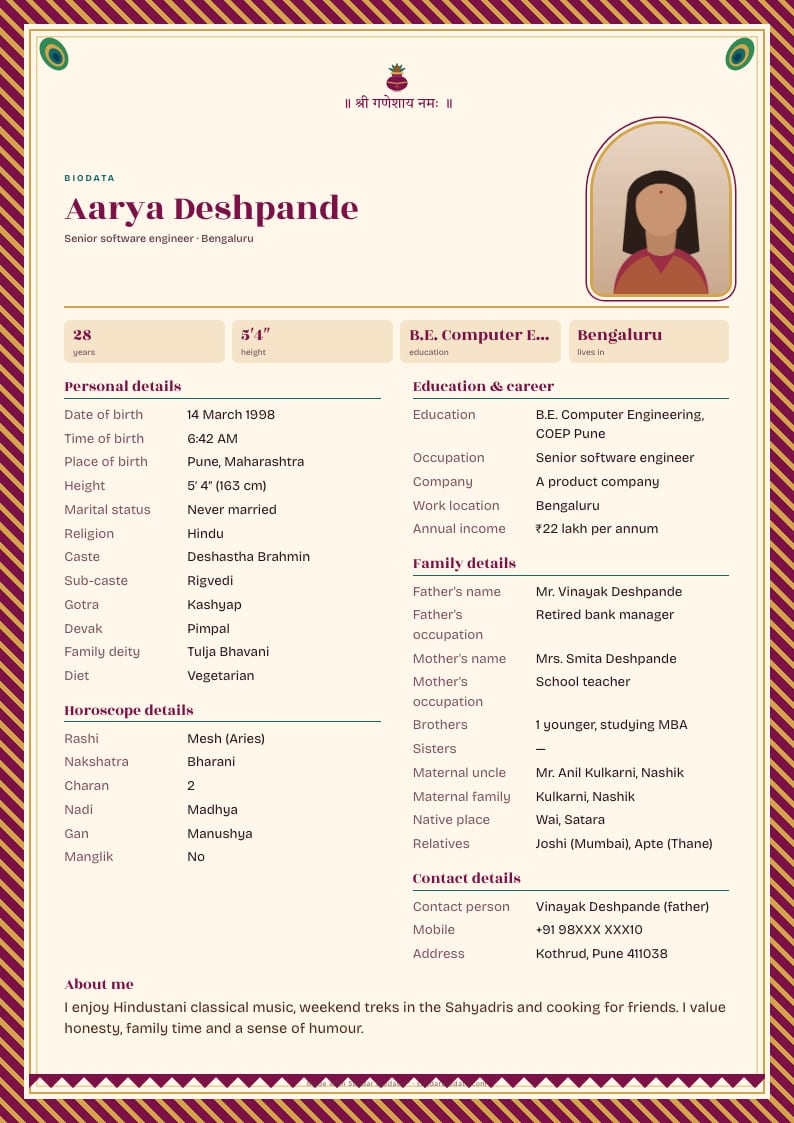
Gotra
A gotra is a family lineage, traced through the father’s line back to an ancient rishi, or sage. Common gotras include Kashyap, Bharadwaj, Vashishtha, Vishwamitra, Gautam, Atri, Jamadagni and Agastya. Everyone born in a family shares the father’s gotra.
Many Hindu families avoid a match within the same gotra, since the two would be from one lineage. Some families also avoid the mother’s gotra. Others don’t consider gotra at all. It is a family custom, not a legal requirement.
To find yours, ask a parent or grandparent, or look at a family puja record or an old wedding card. In a biodata, brides and grooms both write the gotra of their father’s family. Sikh biodatas write the got, the clan name, in the same place, and Jain families often name the gotra within their community.
Nakshatra
A nakshatra is one of 27 parts of the sky that the Moon passes through each month. Your nakshatra, or janma nakshatra, is the one the Moon was in at the moment you were born. It depends on your date, time and place of birth.
Each nakshatra has four quarters called charan or pada, and each rashi (Moon sign) holds two and a quarter nakshatras. That is why many biodatas list rashi, nakshatra and charan together. Families that match horoscopes use the nakshatra to work out several of the eight kootas in guna milan, the 36-point matching system.
To find yours, look at your kundli or janam patrika, where it is written next to the rashi. A family astrologer or a printed panchang can also tell you from your birth details. Our maker doesn’t calculate it. Pick your nakshatra from the list of 27 instead.
| Rashi | Nakshatras in it |
|---|---|
| Mesh (Aries) | Ashwini, Bharani, Krittika (charan 1) |
| Vrishabh (Taurus) | Krittika (2–4), Rohini, Mrigashira (1–2) |
| Mithun (Gemini) | Mrigashira (3–4), Ardra, Punarvasu (1–3) |
| Kark (Cancer) | Punarvasu (4), Pushya, Ashlesha |
| Simha (Leo) | Magha, Purva Phalguni, Uttara Phalguni (1) |
| Kanya (Virgo) | Uttara Phalguni (2–4), Hasta, Chitra (1–2) |
| Tula (Libra) | Chitra (3–4), Swati, Vishakha (1–3) |
| Vrishchik (Scorpio) | Vishakha (4), Anuradha, Jyeshtha |
| Dhanu (Sagittarius) | Mula, Purva Ashadha, Uttara Ashadha (1) |
| Makar (Capricorn) | Uttara Ashadha (2–4), Shravana, Dhanishta (1–2) |
| Kumbh (Aquarius) | Dhanishta (3–4), Shatabhisha, Purva Bhadrapada (1–3) |
| Meen (Pisces) | Purva Bhadrapada (4), Uttara Bhadrapada, Revati |
If your kundli gives your nakshatra and rashi, check that they agree with this table. A mismatch usually means a copying mistake.
Devak
A devak is a family emblem, mostly used by Marathi families, and especially by Maratha, Kunbi, Mali and Dhangar families. It is usually a tree or plant, such as pimpal, vad (banyan), umbar, kalamb or panchpallav (five sacred leaves). For some families it is a bird, an animal or an object.
Families with the same devak are treated as related, so many avoid a match between them. Before a wedding, many families worship their devak in a small ceremony at home, and many avoid cutting or harming their devak tree.
Ask your elders for your family’s devak. If your community doesn’t use one, simply remove the line. On our maker you can hide or delete any field you don’t need.
Other words you may see
| Word | Meaning |
|---|---|
| Rashi | Your Moon sign: the zodiac sign the Moon was in when you were born. |
| Charan or pada | One quarter of a nakshatra. It is written as a number from 1 to 4. |
| Nadi | One of three types, Adi, Madhya or Antya, that come from the nakshatra. Many families avoid a match with the same nadi. |
| Gan | One of three temperaments, Dev, Manushya or Rakshas, also from the nakshatra. |
| Manglik | Mars in certain houses of the birth chart. Some families check it before matching. |
| Kuldevata or kuldaivat | The family deity, such as Tulja Bhavani, Khandoba or Renuka Mata. Gujarati families say kuldevi. |
If you don’t follow these customs
All of these lines are optional. Many families, and most Muslim, Christian, Sikh and Buddhist families, leave the horoscope section out entirely. If you don’t use them, delete the lines. A biodata with fewer, accurate lines reads better than one with guesses.
Questions families ask
Is gotra compulsory in a marriage biodata?
No. Write it if your family considers it when matching. If not, you can leave it out.
I don’t know my gotra. What should I do?
Ask your parents, grandparents or an elder relative, or look at an old family wedding card or puja record. If no one knows, leave it blank rather than guess.
Can I find my nakshatra from my date of birth alone?
Not reliably. The Moon changes nakshatra about once a day, so you need the time and place of birth too. Your kundli is the most accurate source.
Is devak the same as gotra?
No. Gotra traces a lineage back to a sage, while devak is a family emblem, usually a tree or plant. A Marathi biodata often lists both.
Does Sundar Biodata calculate my nakshatra or match horoscopes?
Not yet. You choose your rashi, nakshatra, charan, nadi and gan from lists, copied from your kundli. We will say so on this page if that changes.
More guides
Ready in minutes, on your phone. No sign-up.
Fill these in your biodata